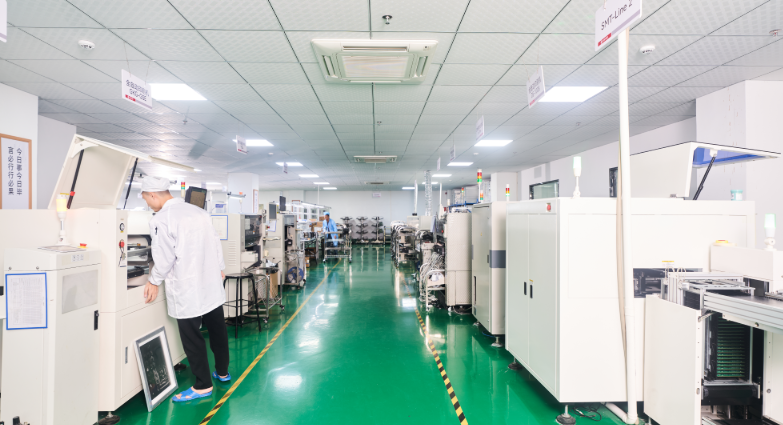
At HTTPROTO, we firmly believe stable production hardware and multi-level inspection systems form the second lifeline of reliable PCBA products. We have built a full-process production line with premium SMT assembly machines and a complete layered quality control framework. Every piece of equipment serves one core goal: to eliminate hidden risks at every manufacturing stage and deliver consistent, high-precision circuit board assemblies to global clients.
The Yamaha YSM20 mounter is the core foundation of our SMT workshop. Featuring dual high-precision placement heads and wide-range optical recognition, it accurately mounts components ranging from tiny 0201 chips to irregular large-size parts with placement accuracy up to ±15μm and a maximum capacity of 40,000 components per hour. Its stable feeding system drastically reduces common assembly defects such as component offset, tombstoning and missing parts. Flexible setup adapts seamlessly to prototype, small-batch and mass production, laying a solid base for uniform assembly quality of all PCB orders.
Solder paste printing is the source of most soldering failures. We deploy precision printing equipment to intercept defects at the front end of production. The machine carries out standardized printing for PCBs, enabling precise control over solder paste thickness, volume and offset. Real-time monitoring alerts operators of insufficient paste, excessive paste and slump issues before component mounting. By optimizing printing parameters at the earliest stage, we avoid downstream short circuits and cold solder joints, greatly cutting rework rates.
For mixed PCBs with both SMD and through-hole components, we adopt closed-loop temperature-controlled nitrogen selective wave soldering equipment. Multi-zone PID temperature control keeps preheat and solder pot temperatures steady within ±2°C, preventing thermal shock, board warpage and component damage. The nitrogen-filled environment reduces oxidation and dross effectively to improve solder wetting performance. Selective soldering nozzles target only designated through-hole pads, protecting delicate nearby SMD chips from thermal damage and excess solder contamination.
We implement a four-step full-chain testing workflow combining automated electrical testing, optical scanning, non-destructive X-ray detection and manual rechecking, forming an all-round quality control barrier after production.
The Takaya Flying Probe performs full electrical verification for all finished boards. Unlike traditional ICT fixtures, it requires no custom tooling, which shortens the verification cycle for new prototype products. It supports 10mΩ opens/shorts detection and 100% netlist verification. Dual moving probes accurately test continuity, resistance, capacitance and diode values to detect opens, short circuits and mismatched component parameters. Automatic optical positioning ensures stable, repeatable electrical test results without manual errors.
After SMT reflow soldering, inline AOI equipment performs 100% full-board scanning with high-resolution cameras and AI defect identification algorithms. The system compares captured board images against standard CAD reference files to automatically identify surface defects: missing components, placement deviation, solder bridging, insufficient solder and reversed component polarity. Automated screening separates defective boards for immediate rework, avoiding defective products flowing into subsequent procedures.
Hidden solder joints under BGA, QFN and CSP chips cannot be detected by AOI, so AXI X-ray Inspection becomes an indispensable quality checkpoint. The equipment supports 3D CT scanning to generate clear 2D and 3D imaging of buried solder balls, detecting invisible critical defects including solder voids, cold joints, solder ball bridging, missing solder balls and head-in-pillow failures. This non-destructive testing fully guarantees the long-term reliability of high-density packaging products for industrial control, communication and consumer electronics.
Manual visual inspection acts as the last quality defense line. Well-trained QC technicians recheck all boards under high-magnification microscopes, cross-verifying all records from flying probe, AOI and X-ray testing. Technicians inspect component labels, board surface cleanliness, solder fillet uniformity and physical damage that automated equipment may miss. This human recheck eliminates subtle cosmetic and minor assembly flaws, ensuring all finished PCBA products meet strict delivery standards before shipment.
At HTTPROTO, advanced production equipment and multi-stage inspection systems work together to build our second lifeline of product quality. From precise component mounting and solder process monitoring to layered electrical, optical and X-ray testing plus final manual verification, every piece of hardware and every inspection procedure aims to minimize defects, maintain production consistency and deliver trustworthy PCBA manufacturing services to global partners. If you are seeking a PCBA supplier with strict full-process quality control and flexible batch production capacity, our complete equipment system and standardized quality management workflow are ready to support all your electronic project demands.